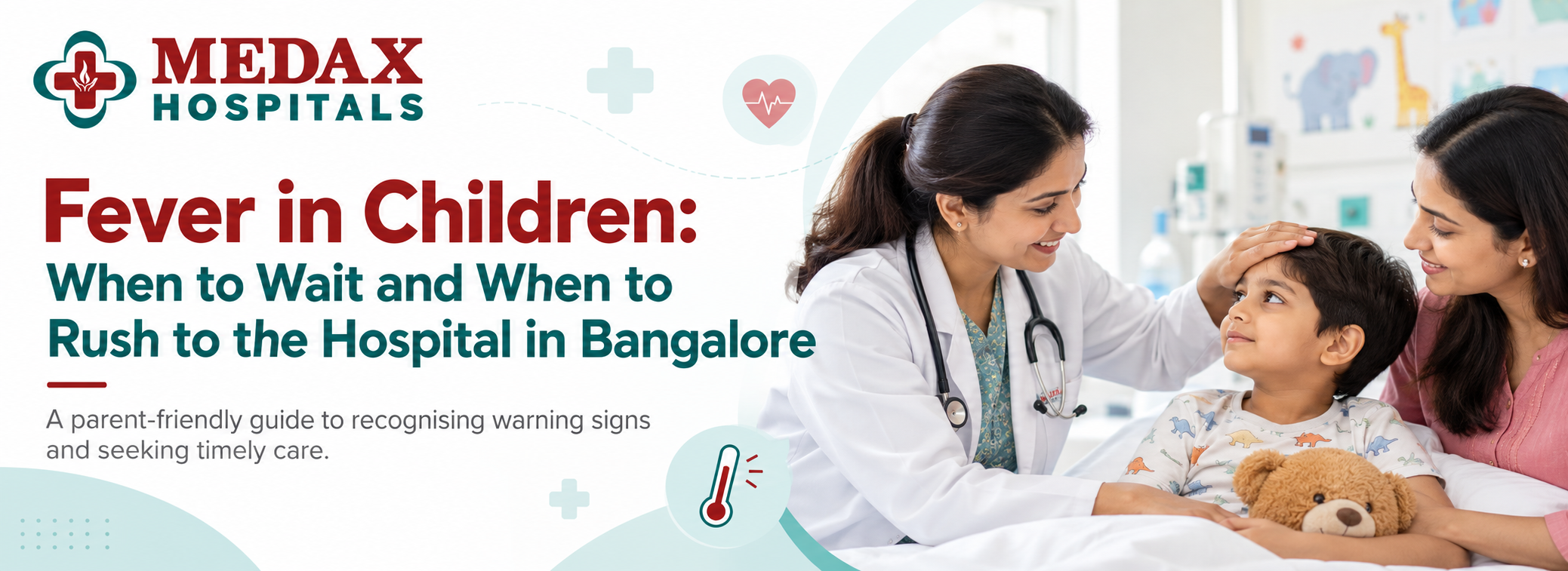
As a parent, few things trigger anxiety quite like touching your child’s forehead and feeling unexpected heat. Fever is one of the most common reasons parents seek urgent medical advice, especially in a bustling metropolis like Bangalore where seasonal weather transitions, changing humidity, and viral outbreaks frequently circulate through schools and daycare centers
When your child develops a high temperature, immediate questions flood your mind: Is this a harmless reaction to a mild cold, or a sign of something more serious? Should I wait and observe at home, or visit a 24/7 pediatric emergency Bangalore facility immediately?
Understanding fever in kids in Bangalore parents experience daily requires knowing how the body responds to illness, identifying warning signs early, and having direct access to a trusted pediatrician on Bannerghatta Road. In this comprehensive guide, expert paediatricians from Medax Hospital break down everything you need to know about fever in children on Bannerghatta Road: when it is safe to wait, when home management is appropriate, and when to go to the hospital.
Understanding Fever in Kids: What is “Normal” vs. Cause for Concern?
First and foremost, it is important to remember that fever is not an illness in itself—it is a healthy immune response. When bacteria, viruses, or other pathogens enter the body, the brain’s thermostat (the hypothalamus) raises the body temperature to create an inhospitable environment for pathogens while boosting white blood cell activity.
In general, a body temperature reading of 100.4°F (38°C) or higher measured with a reliable digital thermometer is classified as a fever. However, the exact temperature reading is only part of the clinical picture. Pediatric specialists emphasize that a child’s overall behavior, energy levels, responsiveness, and age are often far more critical indicators of health than the degree mark on a thermometer.
When evaluating fever in children Bannerghatta Road parents should note that a child with a temperature of 102°F who continues to drink fluids, play comfortably, and respond warmly to parents may be less critically ill than a child with a 100.8°F fever who is unusually lethargic, unresponsive, or experiencing breathing difficulty.
Age-Wise Fever Guidelines: A Quick Reference for Parents
Age plays a pivotal role in determining the severity of a fever. A newborn’s immune system operates very differently from that of an older toddler or school-aged child.
Infants Under 3 Months Old (Critical Priority)
Any fever reaching 100.4°F (38°C) or higher in an infant under 90 days old is considered a medical emergency. Young babies have immature immune systems that make them highly vulnerable to serious bacterial infections. At this age, you should never administer over-the-counter fever medications without explicit physician guidance. Instead, visit a children’s hospital in South Bangalore or an emergency center immediately.
Babies 3 to 6 Months Old
For infants in this age bracket, a fever up to 102°F (38.9°C) can often be observed closely at home if the baby remains alert, feeds well, and shows no additional distress. However, if the temperature exceeds 102°F, persists for more than 24 hours, or is accompanied by unusual irritability, contact a leading pediatrician in Gottigere or your local health clinic promptly.
Children 6 Months to 5 Years Old
In older infants and young children, fevers up to 103°F (39.4°C) are common during viral infections like colds, flu, or throat infections. If the child is active, drinking fluids, and urinating normally, you can manage the fever at home for up to 48–72 hours. However, if the fever persists beyond 3 days or reaches 104°F (40°C), immediate medical evaluation by a child specialist near Bannerghatta Road is strongly recommended.
Red Flag Warning Signs: Child Fever When to Go to Hospital Immediately
While many fevers resolve naturally with rest and fluids, certain “red flag” symptoms indicate that home waiting is unsafe. Knowing child fever when to go to hospital can prevent severe complications. Rush your child to the nearest emergency department if you observe any of the following:
- Extreme Lethargy or Unresponsiveness: The child is difficult to wake up, cannot maintain eye contact, or appears excessively weak and limp.
- Respiratory Distress: Rapid breathing, chest retractions (skin pulling tight between or below ribs), grunting sounds while breathing, or blue/pale lips and fingernails.
- Stiff Neck or Extreme Photophobia: Inability to flex the neck forward to touch the chin to the chest, or severe sensitivity to light (potential signs of meningitis).
- Febrile Seizures: Convulsions, twitching limbs, rolling eyes, or loss of consciousness during a fever spike. While often temporary, any first-time seizure requires urgent emergency evaluation.
- Dehydration Signs: No wet diapers for 6–8 hours in infants, dry mouth/tongue, crying without tears, or sunken eyes and fontanelle (soft spot on infant heads).
- Unexplained Rash: A sudden, non-blanching purple or red spot rash (does not fade when pressed with a clear glass).
- Persistent High Fever: Fever exceeding 103°F (39.4°C) that fails to come down despite proper fever medication dosage.
🚨 EMERGENCY DIRECTIVE: If your child displays any of these warning signs, do not wait for a regular clinic appointment. Visit the Medax Hospital 24/7 pediatric emergency Bangalore room immediately for rapid medical intervention.
Common Causes of Fever in Kids in Bangalore
Living in Bangalore presents unique environmental and seasonal factors that contribute to pediatric fevers throughout the year:
- Monsoon & Post-Monsoon Viral Spikes: Bangalore’s rainy seasons (June to October) bring a significant uptick in mosquito-borne illnesses like Dengue, Chikungunya, and Malaria. High continuous fever accompanied by body pain or vomiting should always be screened early.
- Respiratory Tract Infections: Fluctuating temperatures between morning and night in South Bangalore neighborhoods like Bannerghatta Road, JP Nagar, and Gottigere often trigger viral upper respiratory infections, bronchitis, and croup.
- Gastrointestinal Infections: Contaminated food or water during festival seasons can lead to stomach flu or typhoid fever, presenting with high fever, vomiting, and diarrhea.
- Post-Vaccination Reactions: Mild fevers are common within 24 to 48 hours following routine pediatric immunizations. These are usually harmless and resolve quickly.
Safe Home Care & Dos and Don’ts for Managing Fever in Children
If your child does not display any red flag symptoms and is over 6 months old, you can keep them comfortable at home using evidence-based supportive care:
Essential Home Care Steps
- Prioritize Hydration: Offer small, frequent sips of ORS (Oral Rehydration Solution), clear broths, coconut water, or warm water. Hydration prevents fever-induced dehydration.
- Lukewarm Sponging: If your child feels very hot or uncomfortable, sponge their arms, legs, and neck with lukewarm water. Avoid cold water or ice baths, as they cause shivering, which raises internal body temperature.
- Light Clothing & Comfortable Room: Dress your child in lightweight, breathable cotton clothes. Do not wrap a febrific child in thick blankets, as this traps body heat.
- Proper Medication Usage: Use age-appropriate pediatric paracetamol or ibuprofen as recommended by your pediatrician in Gottigere. Dosing should ALWAYS be based on the child’s weight, not just their age.
What NOT to Do
- ❌ Never Give Aspirin: Aspirin in children or teens with viral fevers is associated with Reye’s syndrome, a dangerous condition affecting the liver and brain.
- ❌ Avoid Cold Baths or Alcohol Wipes: Rubbing alcohol is toxic when absorbed through young skin or inhaled.
- ❌ Do Not Overdose: Never combine multiple cold and fever medicines without consulting a doctor, as many contain identical active ingredients leading to accidental overdosage.
Why Choose Medax Hospital for Pediatric Care on Bannerghatta Road?
When your child is unwell, having access to rapid, high-quality, and compassionate healthcare makes all the difference. Located conveniently in Gottigere, Medax Hospital is recognized as a premier children’s hospital in South Bangalore, serving families across Bannerghatta Road, Hulimavu, Arekere, and nearby regions.
- 24/7 Dedicated Pediatric Emergency Unit: Our emergency department is staffed round-the-clock by experienced pediatric doctors and critical care nurses ready to handle acute high fevers, febrile seizures, and respiratory crises.
- Renowned Pediatric Specialists: Consult with expert pediatrician on Bannerghatta Road professionals who offer thorough, gentle, and child-friendly diagnostic evaluations.
- Advanced NICU & PICU Facilities: As an advanced NICU hospital in Bannerghatta Road, Medax provides level-3 neonatal and pediatric intensive care units for critically ill infants and newborns.
- Comprehensive In-House Diagnostics: Get fast, accurate blood work (including Dengue NS1, Complete Blood Count, and CRP) and imaging under one roof, eliminating stress and delayed treatments.
Frequently Asked Questions:
Q1: What temperature is considered a fever in a child?
A body temperature of 100.4°F (38°C) or higher measured with a digital thermometer is considered a fever in children.
Q2: When should I bring my child with a fever to Medax Hospital on Bannerghatta Road?
Rush to Medax Hospital immediately if your infant is under 3 months (fever ≥ 100.4°F), or if your child exhibits red flags such as severe lethargy, breathing difficulty, stiff neck, persistent vomiting, unexplained rash, or a fever lasting more than 3 days.
Q3: Can teething cause a high fever in toddlers?
Teething may cause a slight, mild rise in body temperature (usually under 100°F), but it does not cause a high fever above 100.4°F. If your teething toddler has a high fever, consult a pediatrician in Gottigere to check for an underlying viral or bacterial infection.
Q4: What should I do if my child has a fever seizure (febrile seizure)?
Stay calm. Place your child on their side on a safe, soft surface to prevent choking. Clear the immediate area, do not put anything in their mouth, and time the seizure. Once it stops, bring your child immediately to our 24/7 pediatric emergency department at Medax Hospital.
Q5: Is it safe to give my child Crocin or Calpol at home?
Yes, paracetamol-based syrups like Crocin or Calpol are safe when administered according to your child’s exact body weight and correct interval instructions given by your child specialist near Bannerghatta Road. Never exceed recommended doses.
Q6: How long can a normal viral fever last in children in Bangalore?
A typical viral fever usually lasts between 3 to 5 days. If the fever continues past 72 hours without signs of improvement, a doctor consultation and basic blood work are recommended.
Q7: Should I use cold water to sponge my febrific child?
No. Always use lukewarm water. Cold water causes blood vessels to constrict and triggers shivering, which raises the core body temperature further.
Q8: What diagnostic tests are performed at Medax Hospital for persistent child fever?
Depending on clinical examination, our doctors may order a Complete Blood Count (CBC), Dengue NS1/IgM test, Urine Routine, CRP (C-Reactive Protein), or throat swab to accurately pinpoint the infection cause.
Q9: Does Medax Hospital have specialized neonatal facilities?
Yes, Medax Hospital is a leading NICU hospital in Bannerghatta Road equipped with advanced level-3 Neonatal Intensive Care Units and specialized neonatologists for high-risk newborns.
Q10: Can I visit Medax Hospital for pediatric care without a prior appointment in an emergency?
Yes. Our 24/7 pediatric emergency Bangalore department accepts walk-ins at any hour of the day or night with zero delay in critical triaging.
Q11: What are the common local fever triggers in South Bangalore during monsoon?
Monsoon months see a surge in mosquito-borne viral infections like Dengue and Chikungunya, alongside respiratory viruses due to weather shifts. Maintaining mosquito protection and clean drinking water is vital.
Q12: How can I tell if my child’s fever is caused by Dengue?
Dengue fever often presents as high continuous fever accompanied by severe pain behind the eyes, joint/muscle pain, skin rash, nausea, or bleeding gums. Early diagnosis at our Gottigere facility is crucial.
Q13: Should I cover my child with heavy blankets if they have chills during fever?
No. While chills make the child feel cold, heavy blankets trap heat and push core temperature higher. Dress them in comfortable cotton clothes and cover with a thin sheet if needed.
Q14: How do I book an appointment with a pediatrician on Bannerghatta Road at Medax Hospital?
You can book directly by visiting Medax Hospital or calling our dedicated hospital helpdesk for immediate appointment scheduling.
8. Conclusion & Emergency Contact Information
A child’s fever can be scary, but with the right knowledge, calm observation, and prompt action when red flags appear, you can ensure your child receives the best care. Remember, while home remedies and rest are sufficient for mild viral fevers, never hesitate to seek professional medical advice when in doubt.
🏥 MEDAX HOSPITAL – South Bangalore’s Trusted Pediatric Center
📍 Address: Bannerghatta Main Road, Gottigere, Bangalore, Karnataka 560083
📞 Emergency Helpline: Available 24/7 for pediatric acute care
🌐 Website & Booking:https://www.medaxhospital.com/
Services: 24/7 Emergency, Outpatient Clinics, Level-3 NICU/PICU, Diagnostic Labs & Pharmacy.